Build a Rasmussen Preceptor Search Across Arizona
In AANP's May 2026 framework, Arizona is a full practice state, and Rasmussen's current 2025-2026 catalog lists the state as Meets for its NP specializations. That is a planning starting point, not approval of a particular preceptor, site, or clinical format.
Tell us your track and city. It is free to ask, with no obligation.
Build a primary and backup market
Geography should follow the course. Across Arizona, possible search centers include Phoenix, Mesa, Chandler, Gilbert, Glendale, Scottsdale, Tucson, and Flagstaff, but family, adult primary care, pediatric primary care, psychiatric care, and DNP practice work will not use the same provider map.
Test travel during actual clinic hours and ask whether the listed office is where patients will be seen. A broad Arizona radius can produce more names, yet it only helps when the student can sustain the schedule through the full rotation.
Separate licensed authority from student supervision
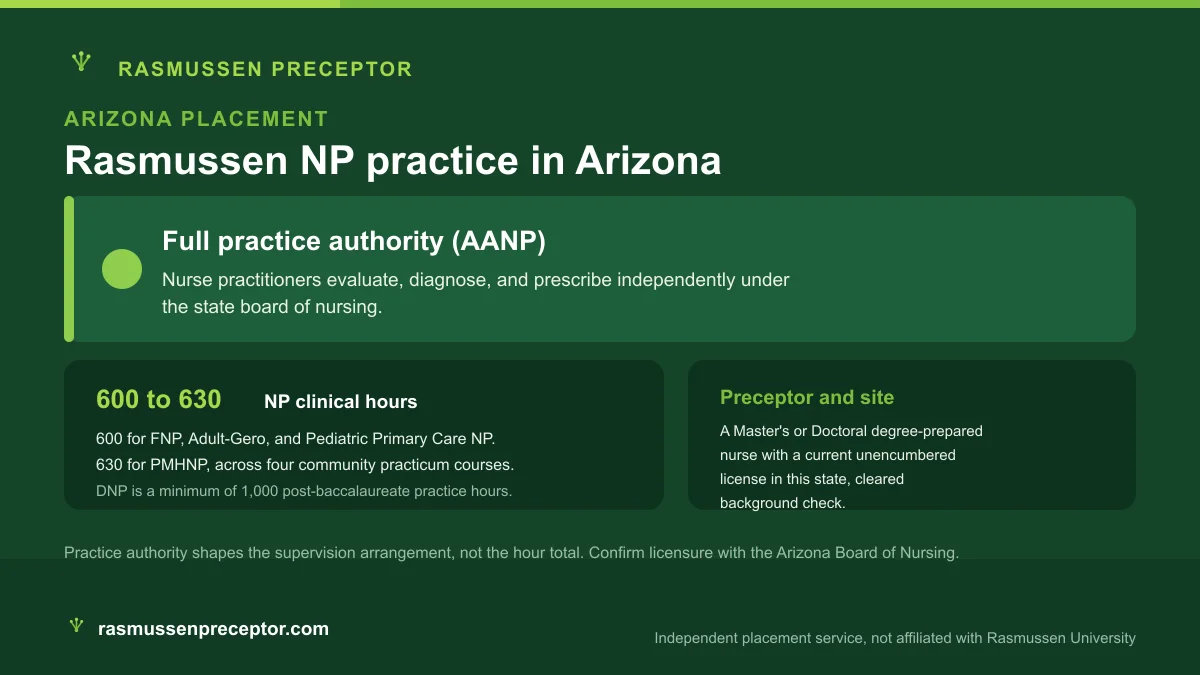
Picture the legal backdrop: AANP classifies Arizona as full practice. In practice near Phoenix, a licensed NP can evaluate, diagnose, order and interpret tests, manage treatment, and prescribe under the authority granted by the nursing framework. That freedom belongs to the licensed clinician. A Rasmussen student still practices under direct preceptor supervision.
Full practice changes the legal setting around the Arizona preceptor, not the school's academic review. For a site near Phoenix, population focus, workplace privileges, patient access, schedule, and teaching capacity still decide whether a clinician can support the assigned course.
Distinguish the 600-hour and 630-hour tracks
A 600-hour headline does not describe one continuous placement. Rasmussen divides FNP, AGPCNP, and PPCNP clinical education into four supervised 150-hour practicums. Build the Arizona calendar around the assigned course, its patients, and the preceptor's real working days.
Arizona PMHNP students plan for 630 hours: three 150-hour practicums followed by one 180-hour practicum. Ask what the current course must document before deciding where to search.
Arizona DNP planning starts with the student's accepted history. Practice work moves the learner toward at least 1,000 post-baccalaureate hours, and the remaining amount depends on prior accepted hours and course requirements.
Use the nursing regulator before relying on a lead
Start the clinician check with the Arizona State Board of Nursing, using the legal name rather than a shortened profile name. For a lead near Phoenix, confirm the current RN or APRN record, population focus when shown, and any public restrictions. A health system biography can be outdated or incomplete.
A student completing hours in Arizona needs an unencumbered RN or APRN license there. In the Phoenix-area file, that student requirement and the preceptor's credential review belong in the same Arizona planning file, but they are separate checks.
For a proposal in Arizona, Rasmussen describes the NP preceptor as a Master's or Doctoral degree-prepared nurse. For an Arizona proposal centered on Phoenix, document that education, specialty certification, license, practice address, patient groups, available days, and the organization's education contact.
Meets does not mean that any Arizona clinician or organization is ready for use. For a candidate near Tucson, the university and site still consider the course, patient population, credentials, schedule, supervision, affiliation needs, and onboarding before clinical activity begins.
Make the current catalog the first gate
The current Rasmussen 2025-2026 catalog places Arizona in the Meets group for the NP specializations. Treat that entry as an initial eligibility check. Before outreach near Tucson, confirm it again for your specialization and start term because a catalog status is not permanent.
Combine school support with targeted sourcing
Treat a promising Arizona conversation as a lead until review is complete. The Rasmussen clinical practicum coordinator helps find and secure the clinical site and locate practicum experiences, and should receive accurate candidate details before the student relies on a start date.
Keep all locations accurate in the proposal. Within a search near Tucson, a change in patient location, office, preceptor, or delivery method can create a new review question even when Arizona remains listed as Meets.
Organize the Arizona proposal while sourcing is active. Record who controls student approval, the site's deadline, exact patient location, preceptor working days, credentials, and open compliance items. Do not begin hours while university or organization clearance remains incomplete.
Place online coursework beside in-person duties
If local networking in Arizona has run out, we can build another candidate list around the exact course. That includes physical placements and potentially eligible virtual arrangements, but every candidate route still goes through the applicable school and site process.
An Arizona student can complete Rasmussen coursework online, but the published practicum model is in person within the student's community. The program also includes one weekend of on-campus residency, so travel planning has both local and campus components.
For Arizona students, simulation, telehealth, and standardized patients appear in Rasmussen's virtual immersion for preclinical preparation. That language should not be stretched into a claim that every supervised practicum accepts remote hours.
In Arizona, we screen physical placements and virtual preceptorship possibilities. Any remote clinical arrangement must fit the present course and receive the required confirmation across university, state, patient location, organization, preceptor, technology, privacy, and supervision.
Add another sourcing channel
A stalled Arizona search becomes easier to assess when the request is specific. Use the free placement review to provide specialty, course, patient needs, dates, schedule, commute, and acceptable physical or virtual routes.
We present the Arizona match before payment, and the student pays only when placement is secured. The cost page owns current pricing. Trusted by nursing students and working nurses. Sourcing does not replace university or site decisions.
Good to know
How should a schedule near Phoenix account for Rasmussen NP hours?
FNP, AGPCNP, and PPCNP each publish 600 hours across four 150-hour practicums. For scheduling near Tucson, PMHNP publishes 630 hours across practicums of 150, 150, 150, and 180 hours.
Could a virtual clinical route be considered for patients around Tucson?
A virtual Arizona clinical route may be considered only when the current course, Rasmussen, the state, patient location, site, preceptor, technology, privacy, and supervision setup allow it. Confirm accepted activity first.
Where does Rasmussen coordinator support fit in a the Valley and northern Arizona search?
Rasmussen says its clinical practicum coordinator helps find and secure the clinical site and locate practicum experiences. Students searching around Phoenix can share Arizona and workplace leads, and an outside sourcing service can develop additional candidates for review.
For planning purposes, what is Arizona?
AANP currently classifies Arizona as full practice. For a rotation near Phoenix, the category describes licensed NP authority, while a Rasmussen student remains supervised and must follow the course and site process.
What does the current catalog say for a Rasmussen student near Phoenix?
The presently published catalog lists Arizona as Meets for the NP specializations. Before approaching a clinician near Tucson, confirm the current entry for your start term and obtain approval for the specific site and preceptor.
Secure your site, not your stress
Tell us your track, your city, and your practicum timeline. We will come back with a placement plan and a realistic path to a confirmed preceptor and your clinical hours.