Rasmussen NP Preceptor Planning for California
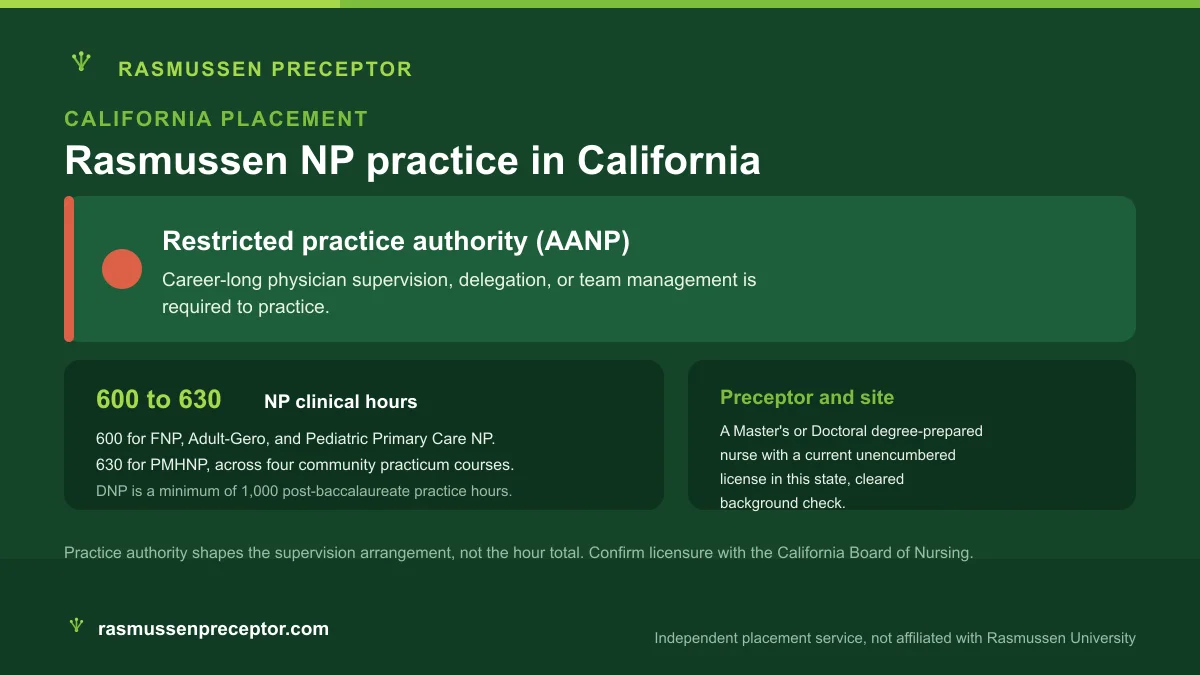
In AANP's May 2026 framework, California is a restricted practice state, and Rasmussen's current 2025-2026 catalog lists the state as Meets for its NP specializations. That is a planning starting point, not approval of a particular preceptor, site, or clinical format.
Tell us your track and city. It is free to ask, with no obligation.
Turn a provider name into a credentialed candidate
Meets does not mean that any California clinician or organization is ready for use. For a candidate near Sacramento, the university and site still consider the course, patient population, credentials, schedule, supervision, affiliation needs, and onboarding before clinical activity begins.
For a proposal in California, Rasmussen describes the NP preceptor as a Master's or Doctoral degree-prepared nurse. For a California proposal centered on Los Angeles, document that education, specialty certification, license, practice address, patient groups, available days, and the organization's education contact.
A student completing hours in California needs an unencumbered RN or APRN license there. In the Los Angeles-area file, that student requirement and the preceptor's credential review belong in the same California planning file, but they are separate checks.
Start the clinician check with the California Board of Registered Nursing, using the legal name rather than a shortened profile name. For a lead near Los Angeles, confirm the current RN or APRN record, population focus when shown, and any public restrictions. A health system biography can be outdated or incomplete.
Make the eventual review easy: keep one current California file with the track, course, required patients, dates, weekly pattern, travel boundary, site contact, address, preceptor degree and credential details, and every pending university or facility step.
Compare metro capacity with regional travel
Start local, then widen with purpose across California. Consider Los Angeles, Orange County, San Diego, the Bay Area, Sacramento, Fresno, Bakersfield, Riverside, and San Bernardino, measuring each area against patient needs, course dates, travel, and the student's work schedule rather than against city size alone.
When outreach moves beyond the nearest clinic, tell each organization exactly which Rasmussen practicum is involved. Specific dates, population focus, and weekly availability give a California education office or practice manager enough information to make a useful decision.
Define the preceptor's working authority
Two reviews meet at a California placement. AANP's restricted practice label explains the licensed NP environment, while Rasmussen evaluates a supervised learning experience. Neither review replaces the other.
Restricted practice does not remove the NP from clinical decision making. A California preceptor may assess, diagnose, order tests, treat, and prescribe within current authorization and workplace rules. The proposal should accurately describe oversight, consultation, and the clinician's actual role.
Confirm the education determination early
The current Rasmussen 2025-2026 catalog places California in the Meets group for the NP specializations. Treat that entry as an initial eligibility check. Before outreach near Sacramento, confirm it again for your specialization and start term because a catalog status is not permanent.
Use workplace leads only when the learning role fits
Three parties shape the search: the student supplies accurate constraints and leads, Rasmussen's practicum coordinator helps locate practicum experiences, and the organization controls its own student capacity. A clear California request keeps those roles connected.
When a California search needs more candidates, we source clinicians outside the student's immediate network. The aim is a review-ready possibility, not an informal promise that bypasses Rasmussen or facility onboarding.
Keep DNP calculations student specific
For California scheduling, sequence matters as much as total time. Rasmussen's FNP, AGPCNP, and PPCNP tracks each publish four supervised 150-hour practicums, totaling 600. The PMHNP track publishes 630 through courses of 150, 150, 150, and 180 hours.
California DNP learners work from accepted prior practice hours toward a 1,000-hour post-baccalaureate minimum. Their remaining practice work is student specific, so the degree audit and current course materials are the proper sources.
Keep the candidate record current
Keep all locations accurate in the proposal. Within a search near Sacramento, a change in patient location, office, preceptor, or delivery method can create a new review question even when California remains listed as Meets.
For a California request, name the exact practicum and requested dates. Patient needs and site fit can change from one course to the next, even inside the same specialty.
In California, preserve two sourcing paths while keeping the academic distinction clear. Rasmussen publishes in-person community practicums alongside online coursework and one weekend of campus residency. Its virtual immersion is preclinical preparation using simulation, telehealth, and standardized patients.
We continue to offer physical placement and virtual preceptorship routes for California. Virtual clinical use is possible only when the present course, Rasmussen, state, patient location, site, preceptor, technology, privacy, and supervision setup permit the proposed activity.
Before counting remote encounters in California, ask what the current course will accept. A virtual immersion, a telehealth-enabled clinic, and an approved virtual practicum route are not interchangeable terms.
Get support when local outreach runs out
Bring a difficult California request to a free placement review, including your track, practicum, preferred dates, work schedule, travel radius, and whether a physical placement or eligible virtual route could be considered.
The proposed California match is shown before payment, which is due only when placement is secured. Pricing is kept on the cost page. Trusted by nursing students and working nurses. Every candidate remains subject to the applicable review steps.
Good to know
Where does Rasmussen coordinator support fit in a the Central Valley and far northern counties search?
Rasmussen says its clinical practicum coordinator helps find and secure the clinical site and locate practicum experiences. Students searching around Los Angeles can share California and workplace leads, and an outside sourcing service can develop additional candidates for review.
How does AANP classify California?
AANP currently classifies California as restricted practice. For a rotation near Los Angeles, the category describes licensed NP authority, while a Rasmussen student remains supervised and must follow the course and site process.
What does the current catalog say for a Rasmussen student near Los Angeles?
The current catalog lists California as Meets for the NP specializations. Before approaching a clinician near Sacramento, confirm the current entry for your start term and obtain approval for the specific site and preceptor.
How should a schedule near Los Angeles account for Rasmussen NP hours?
FNP, AGPCNP, and PPCNP each publish 600 hours across four 150-hour practicums. For scheduling near Sacramento, PMHNP publishes 630 hours across practicums of 150, 150, 150, and 180 hours.
Could a virtual clinical route be considered for patients around Sacramento?
A virtual California clinical route may be considered only when the current course, Rasmussen, the state, patient location, site, preceptor, technology, privacy, and supervision setup allow it. Confirm accepted activity first.
Secure your site, not your stress
Tell us your track, your city, and your practicum timeline. We will come back with a placement plan and a realistic path to a confirmed preceptor and your clinical hours.