Plan a Rasmussen clinical placement in Texas
Texas is a restricted practice state under AANP's May 2026 category. Rasmussen's current catalog state-eligibility table lists Texas as Meets, but students should confirm current program eligibility and approval of the exact clinical site before sourcing.
Tell us your track and city. It is free to ask, with no obligation.
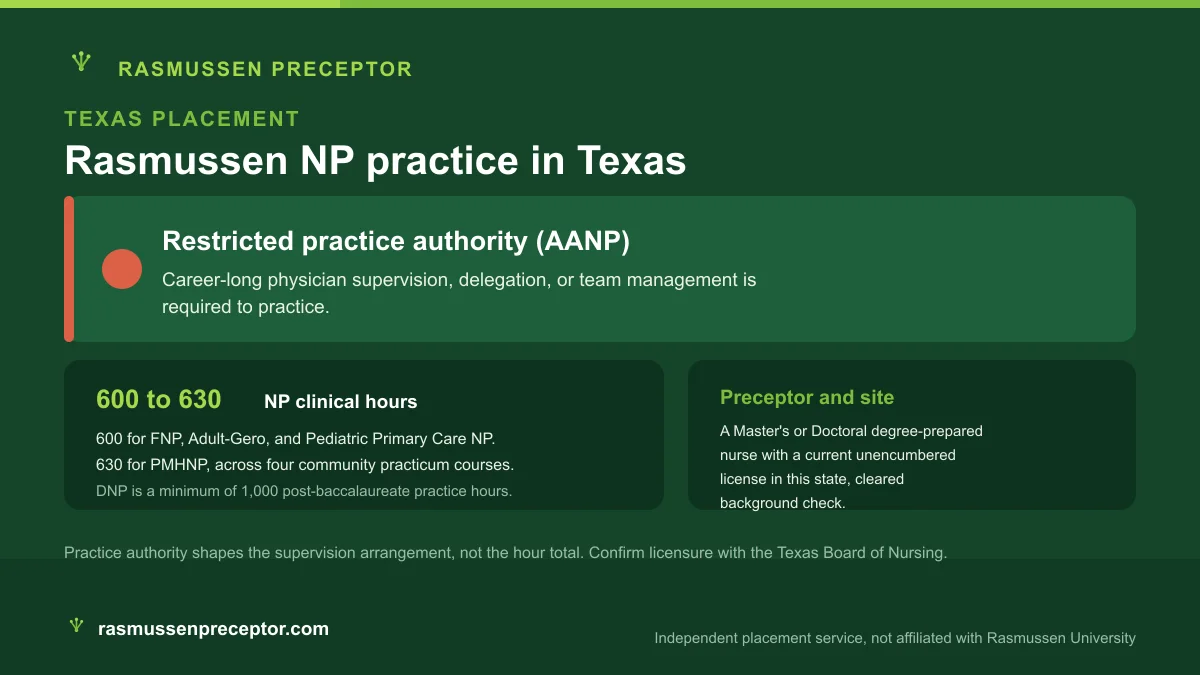
Read Texas authority through the licensing record
AANP classified Texas as a restricted practice state in May 2026. Nurse practitioners in Texas deliver assessment, diagnosis, treatment, and prescribing care within requirements that mandate physician supervision, delegation, or team involvement for at least one practice element. The clinician's current structure must fit the proposed site.
Restricted practice does not determine teaching quality in Texas. For a Texas search, verify local compliance, then assess specialty, patient access, schedule, and supervision time. A Rasmussen student completing hours in Texas remains supervised under the approved course and facility policies. In Texas, begin with the authority shown in the current licensing record.
Credential review starts with the Texas Board of Nursing APRN Practice Information, not a directory profile. Confirm the nurse's legal name, active status, APRN role and population focus, and any public condition that applies where the student would complete clinical activity.
Rasmussen also calls for a Master's or Doctoral prepared nurse preceptor with a current, unencumbered RN or APRN license in that state. Check the graduate degree, specialty match, patients, organization, and teaching availability as a single candidate record. A candidate serving Dallas-Fort Worth, Houston, San Antonio, and Austin still needs this complete credential and population check.
Confirm current Rasmussen eligibility in Texas
Rasmussen's current catalog lists Texas as Meets in its state-eligibility table. For Texas, treat that as a current catalog entry rather than a promise that every student, course, preceptor, or organization will qualify.
Before Texas outreach, confirm current eligibility with Rasmussen and identify the exact site address. A clinic beyond the Texas border, a relocated student, or a telehealth patient in another jurisdiction creates a different review question. Use a proposed address near Dallas-Fort Worth, Houston, San Antonio, and Austin, or the actual alternate corridor, when requesting that decision.
Build a Texas search by care market
Dallas-Fort Worth, Houston, San Antonio, and Austin hold the largest clinical markets. El Paso, Lubbock, Amarillo, Abilene, Waco, Temple, Killeen, and Corpus Christi provide regional anchors. McAllen and Brownsville serve the Rio Grande Valley, while Tyler, Longview, Beaumont, Midland, and Odessa add eastern and western options.
Texas size makes a precise metro, schedule, and drive-time brief more useful than a statewide list.
A precise Texas brief should name the track, practicum course, required patient population, term dates, weekly availability, and repeatable travel radius. Ask which Texas system education office, clinic manager, or individual practice owner controls student access. Center the Texas brief on Dallas-Fort Worth, Houston, San Antonio, and Austin or another named corridor rather than a statewide assumption.
Fit Texas sites to Rasmussen clinical hours
Use four rotations as the basic NP planning unit. FNP, AGPCNP, and PPCNP each use four 150-hour courses for 600 hours. PMHNP uses three 150-hour courses and a final 180-hour course for 630 hours. Use these totals when estimating realistic capacity at a Texas practice.
Population determines placement value. FNP requires family primary care, AGPCNP adult and older-adult primary care, PPCNP pediatric primary care, and PMHNP psychiatric assessment and management. Confirm the course before accepting a broad provider label. Screen the Texas patient panel before discussing a full practicum commitment.
Calculate a sustainable weekly pace from the course total and site calendar. Patient census, holidays, preceptor leave, and limits on student days may make a second practice necessary even when the first clinician is qualified. The market around Dallas-Fort Worth, Houston, San Antonio, and Austin may still require more than one organization across the sequence.
DNP students use an individual calculation toward a minimum of 1,000 post-baccalaureate practice hours. Rasmussen should verify prior accepted hours, remaining activities, project fit, and the current preceptor standard for that student. A Texas DNP plan must use the student's individual university calculation.
Coordinate the Texas search with Rasmussen support
The local search has a built-in school contact. Rasmussen's clinical practicum coordinator helps students find and secure the clinical site in their community, and a current workplace may be proposed when the role and setting meet course rules. Preceptor eligibility remains part of site review. For a Texas plan, local means the approved clinical site, not merely the student's residence.
Our sourcing can operate in parallel by identifying additional clinicians and organizations that match the brief. Every prospect still moves through Rasmussen review and the host's own education, compliance, and onboarding decisions. Keep a search around Dallas-Fort Worth, Houston, San Antonio, and Austin coordinated with the school process and the organization contact.
Separate Texas practicum from virtual immersion
Online coursework is paired with local, in-person practicum attendance, not substituted for it. The NP schedule also contains one weekend campus residency. Add travel, employment, onboarding, and clinic shifts before judging whether a placement is practical. Travel from Texas for the campus weekend remains a separate calendar item.
Virtual immersion is a separate readiness experience using simulation, telehealth, and standardized patients. It is not automatically clinical practicum credit and should not be used to reduce the physical plan without written course confirmation. A Texas proposal should keep simulation and practicum documentation distinct.
We offer physical placement and virtual preceptorship routes. Any virtual clinical route depends on current Rasmussen approval, course design, Texas requirements, patient jurisdiction, host policy, preceptor credentials, and supervision.
Add placement support to the Texas search
A useful Texas request identifies the track, practicum, patients, start and end dates, weekly availability, travel corridor, and whether a physical or conditional virtual route is sought. We source and organize prospects for review rather than promise acceptance.
Students examine the proposed match before payment and pay only once placement is secured. Pricing stays on the cost page, and the service covers sourcing, verification, and compliance coordination. Trusted by nursing students and working nurses. Keep cost and approval decisions separate in the Texas search.
Submit the details through a free placement review. We will identify likely search paths and missing information, while Rasmussen and the practice keep their respective approval roles. Include Dallas-Fort Worth, Houston, San Antonio, and Austin only when it is a repeatable clinical travel option.
Good to know
Is Texas a restricted practice state?
Yes. AANP's May 2026 category lists Texas as restricted practice. The Texas category describes NP authority and does not approve a Rasmussen student or site.
Does Rasmussen help with clinical site planning in Texas?
For a Texas placement, Rasmussen describes a clinical practicum coordinator who helps find and secure the clinical site. Students planning Texas hours should involve that coordinator early and submit any site and preceptor candidate for current review.
How many clinical hours do the Rasmussen NP tracks require?
FNP, AGPCNP, and PPCNP each require 600 hours through four 150-hour practicums. PMHNP requires 630 hours through 150, 150, 150, and 180-hour practicums.
Can a Rasmussen Texas practicum be virtual?
A Texas virtual clinical arrangement is conditional on current Rasmussen approval, the course, state, patient location, site, preceptor, and supervision. Virtual immersion for a Texas student is not automatically practicum.
Secure your site, not your stress
Tell us your track, your city, and your practicum timeline. We will come back with a placement plan and a realistic path to a confirmed preceptor and your clinical hours.